
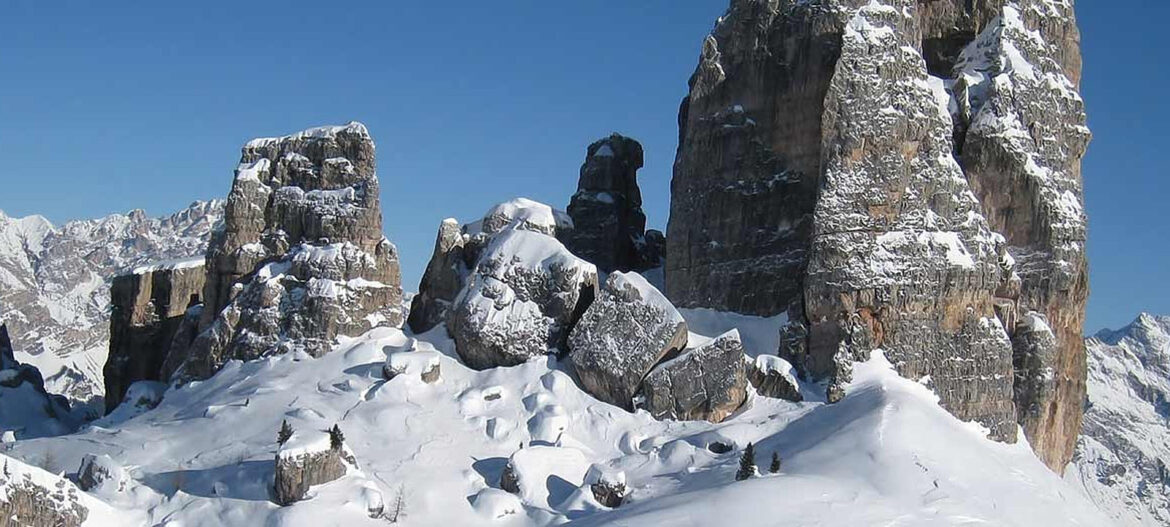
Beyond the postcard
Cortina d’Ampezzo is photographed relentlessly — peaks of the Tofane, light cutting across Faloria, the basin framed like a stage. Cortina d’Ampezzo is photographed relentlessly — peaks of the Tofane, light cutting across Faloria, the basin framed like a stage. But the town is revealed after the spectacle thins. Once the holidays end and the crowd disperses, Cortina does not collapse into silence. It returns to proportion. The town recalibrates, and in that recalibration its character becomes visible.
Altitude here is not decorative. It conditions daily life.
Houses built before aesthetics
Traditional ampezzano houses reveal this clearly. Stone grounds the lower level. Timber rises above. The rear wooden volume — once stable and hay storage — functioned as insulation long before the language of sustainability existed. Balconies are carved for airflow. Ceilings are thick for heat retention. Fireplaces are placed with purpose.
Even in twentieth-century reinterpretations — from Luigi Vietti’s alpine classicism to Edoardo Gellner’s modernist precision — climate precedes style. Wood and glass, steel and carved beams coexist, but the environmental logic remains intact. These are not scenographic chalets. They are dwellings shaped by winter.
Inside, old skis hang beside contemporary lighting. Peltro pitchers line heavy wooden dressers. Platforms for ceramics stand next to steel staircases. It is layering without irony.
The season after the season
Cortina changes tone after early January. Writers have long noted the exodus — the feeling that the town empties overnight. Yet it is in this interval that Cortina feels most itself. Craftsmen reopen workshops. Ski club banners sit in windows without event lighting. Conversations slow.
The approaching Milano–Cortina 2026 Olympics have intensified visibility, but they have not replaced the town’s underlying rhythm. Cortina has hosted the world before. What matters is not the spotlight, but what remains when it shifts.
Dining at altitude
Mountain dining here is not only about indulgence; it is about placement. On the slopes, terraces like Masi Wine Bar “Al Druscié” or the refuge Averau balance altitude with warmth — risotto all’Amarone, venison with polenta, fresh pasta served against open horizons. In town, Tivoli and Alajmo reinterpret alpine and Adriatic traditions without theatrical excess.
Even concept chalet restaurants emerging near the Tofane operate within proportion. At this elevation, excess reads quickly. Refinement requires control.
Living in winter
A chalet in Cortina must function before it impresses. Access roads freeze. Deliveries require timing. Light fades early. Staff housing matters. Heating systems matter. Silence matters.
Guests who choose Cortina in mid-winter are not looking only for visibility. They are looking for clarity. For air that sharpens. For interiors that hold warmth against vastness. The experience depends on coordination as much as comfort.
Altitude shapes behavior. It rewards preparation. It clarifies proportion. It filters noise.
Cortina remains an alpine town that has learned how to host without dissolving itself. And that distinction — more than the peaks, more than the calendar — is what continues to draw those who return.
Chalet life at altitude
To rent a chalet in Cortina is not simply to secure square meters and a view. It is to commit to winter conditions. Access roads freeze. Deliveries require foresight. Kitchens must sustain long stays. Heating systems are not decorative details but structural necessities.
A chalet here functions as a winter home. Its success depends less on square footage than on calibration — sun exposure, storage, service access, proximity to lifts without sacrificing quiet.
Extended stays in Cortina work best when daily life is coordinated rather than improvised. Provisioning must anticipate weather. Transport must anticipate slope schedules. Meals anchor the day. Timing becomes part of comfort.
This is where presence matters — a consistent on-site team that turns seasonal rental into inhabited space. A consistent on-site team transforms a chalet from seasonal rental into inhabited space, integrating culinary rhythm, winter logistics and local knowledge into daily flow.
At altitude, comfort is never accidental.
Cortina does not demand attention.
It rewards staying long enough to notice.
Inquiries
If you are planning a winter stay in Cortina d’Ampezzo and want to understand whether a private chalet or villa aligns with your way of staying, Casa Duo is available to discuss alignment, dates, and fit.
Yes. Cortina balances winter sport with town life, walks, cafés, and social rituals. Skiing is present, but not dominant.
Absolutely. Cortina works well for guests who want movement without obligation and days that unfold naturally.
Its compact scale and familiarity allow guests to return year after year without needing reinvention.