
Capri Was Never Meant for Everyone—and Never Tried to Be
An island within the Gulf of Naples where geography, not marketing, decides who remains
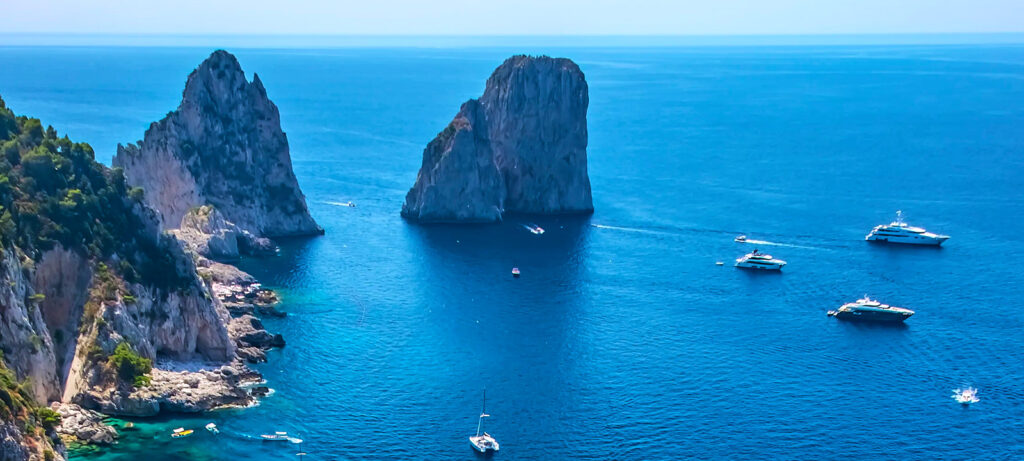
Capri appears crowded long before it feels inhabited. From Naples the crossing takes less than an hour in calm water, and by late morning the boats have done their work. Marina Grande fills, the Piazzetta tightens, cameras tilt toward the Faraglioni in synchronized repetition. The island seems almost consumed by its own image.
Yet exposure is not the same as absorption. Capri has always functioned as a threshold rather than a container. It receives the world daily and releases it again by evening. Circulation is constant; permanence is not.
Most who arrive do not stay the night. Fewer remain beyond a season. What endures after sunset is smaller, quieter, more deliberate. Ownership here is not casual. It is logistical. It requires timing, access planning and acceptance of limitation.
Capri was never structured to accommodate everyone. Its landmass forbids it.
The island that empties itself
There is a moment in late afternoon when the tone shifts. Ferries prepare for departure, luggage reappears at portside and guides lower their voices. The island exhales.
By early evening movement changes direction. Those who remain begin to recognize one another. Cafés thin, restaurants that were inaccessible at midday become conversational and terraces regain priority over streets. Capri operates on a daily filtration system: the sea brings volume, and the sea removes it.
This rhythm has existed for decades. What matters is not scale but pattern. The island is physically incapable of expanding to match its fame. Roads cannot widen. Cliffs do not negotiate. Buildable terrain is finite.
Scarcity here is geological. Properties overlooking the Faraglioni or positioned along the island’s vertical terraces are limited not by zoning strategy but by rock formation. Inventory moves slowly. Transfers are often intergenerational. Renovations preserve sightlines rather than reinvent them.
Unlike linear coastal regions where traffic passes continuously, Capri has no through-route. Entry requires intent — a ferry booking, a private launch, an alternate weather plan. Approach is maritime and deliberate, and that deliberateness shapes behavior. It discourages improvisation and rewards foresight.
The equation is simple: adjacency without intrusion. That equation explains why Capri continues to function as refuge even at the height of its popularity.
A history of deliberate distance
Capri’s narrative is often told through spectacle. Its deeper pattern is continuity.
Curzio Malaparte’s house on Punta Massullo illustrates that continuity through architecture. Built into a cliff and accessible only by footpath or boat, Casa Malaparte eliminates incidental visibility. There is no driveway, no casual arrival. The horizon dominates the structure and access is intentional.
Earlier still, Emperor Tiberius used the island as imperial withdrawal. In the twentieth century Villa Lysis transformed social exile into cultural inheritance. Even industrial ambition left its mark through infrastructure rather than spectacle: the serpentine Via Krupp reshaped circulation without altering scale.
Capri metabolizes drama into permanence. Pablo Neruda once wrote that it was forbidden not to smile at problems here. The phrase captured something essential — compression into smaller frames, limited land, vertical separation and maritime approach. Capri has always filtered.
Norman Douglas once wrote, “Capri is the place where nobody is shocked at anything,” a remark that sounds indulgent until one lives there long enough to understand it differently. The sentence is not about excess. It is about tolerance. Capri has always allowed reinvention without collapse. It absorbs personality, exile, ambition, and retreat without reshaping itself around them.
Continuity as the true privilege
For short visits Capri can feel congested. Provisioning requires timing. Luggage transfers depend on port schedules and weather can shift access patterns within hours.
For those staying two weeks or longer, the constraints reveal predictability. Once rhythms are understood friction diminishes. Mornings are planned before boats arrive, midday congestion is navigated strategically and evenings become private. Supply routes align with ferry timetables. Moorings are confirmed in advance.
The island rewards continuity. Unlike the Amalfi Coast — panoramic and exposed — Capri does not expand laterally; it ascends vertically. Terraces hide behind terraces. Approaches are stepped rather than driven. Amalfi performs. Capri withdraws.
Withdrawal is not isolation. Naples remains within reach in calm conditions. Cultural and logistical infrastructure are accessible without residency in density. Guests move outward during the day and return to insulation by night.
But insulation requires management. Fragmented staffing introduces friction precisely where the island already imposes it. Multiple points of contact multiply variables and agency handovers dilute continuity. On terrain where access is intentional and supply chains are finite, cohesion matters.
An integrated on-site presence — synchronized logistics, coordinated meals, aligned reservations — transforms constraint into ease. Boat days correspond with sea state rather than impulse. Dining reflects sourcing windows. Adjustments are absorbed before they become requests.
On Capri, structure is not optional. It is the condition of comfort.
By late evening, when terraces glow above dark water and the port quiets to residual hum, the island feels smaller again. Not diminished — refined. Those who remain are those who chose to remain.
Capri was never meant for everyone. Its cliffs enforced it. Its sea preserved it.
In an era when many destinations expand to accommodate demand, preservation has become the rarest form of privilege. Beauty opens the conversation. Continuity decides who stays.