
Tuscany Was the Heart of Italy.
It Still Is.
How one hour from Florence becomes a lifetime of discretion
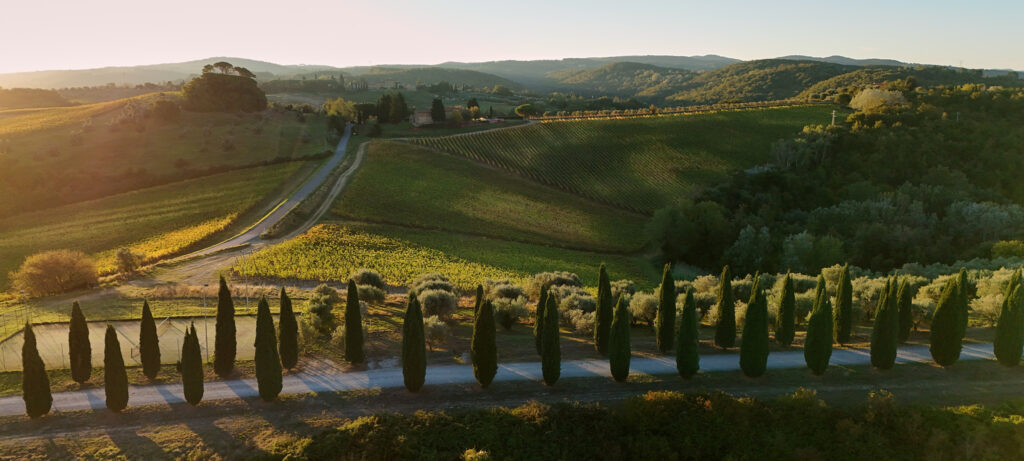
Tuscany has never relied on remoteness. It relies on distance measured precisely.
From Florence, the countryside begins within minutes. Vineyards extend toward Chianti. Cypress roads thread through Val d’Orcia. High-speed rail and international air routes keep the region connected to Milan, Rome, London, New York. Yet within an hour, boardroom tempo dissolves into agricultural rhythm.
This is not isolation. It is calibrated proximity. Tuscany converts nearness into insulation.
Power Without Withdrawal
The Medici understood this geometry centuries ago. They did not retreat to distant provinces; they built estates within reach of Florence’s banks, workshops, and theaters. Villas such as La Petraia and Castello embodied agricultural control and cultural patronage without severing urban ties.
Power expanded outward while remaining anchored.
That logic persists. Contemporary UHNW families acquire properties near Florence not to escape infrastructure but to command it selectively. An owner can attend a meeting in the city by morning and host dinner among olive groves by evening. Distance remains flexible.
Unlike mountain refuges or island retreats that demand disconnection, Tuscany preserves adjacency to influence.
Scarcity Engineered by Landscape
Geology and regulation reinforce the model. UNESCO-protected zones in Val d’Orcia and San Gimignano restrict volumetric expansion. Hillside gradients limit dense construction. Agricultural protections safeguard vineyard and olive groves from subdivision. Conservation laws reduce annual listing turnover to a fraction of visible demand.
Prime hilltop villas trade between €4,000 and €8,000 per square metre, with closing prices frequently below initial asking but rarely collapsing. Foreign buyers represent a significant share of premium transactions — Americans often leading interest cycles at 25–30% — yet transfers remain disciplined, frequently passing through private networks or estate channels. Hold periods commonly extend ten to fifteen years or longer. Intergenerational transfers are routine. Cash purchases dominate upper tiers. This is not speculative territory. It is continuity terrain.
Scarcity here does not produce volatility; it produces patience.
Cultural Density as Stabilizer
Tuscany’s advantage lies not only in what it excludes but in what it contains. Florence, Siena, Pisa — these are not distant excursions but immediate reference points. Within ninety minutes, one moves from Renaissance galleries to vineyard terraces. Uffizi in the morning, private estate by afternoon. Culture reinforces property rather than competing with it.
In mass-tourism corridors — parts of the Amalfi Coast or segments of Sardinia — geography concentrates visibility and amplifies turnover. Tuscany disperses attention across hills, villages, and agricultural estates. Infrastructure remains present yet unobtrusive. Proximity multiplies optionality without multiplying exposure.
Ownership as Positioning
In Tuscany, ownership is positional rather than performative.
Properties are restored for endurance, not resale. Stone farmhouses become compounds with guest annexes. Vineyards integrate production with residence. Olive harvests align with family calendars. Luxury here unfolds through daily cadence rather than event spectacle.
Cash transactions account for a majority of high-tier acquisitions. Negotiation remains measured. Yield expectations are secondary to lifestyle durability. Long-term appreciation in prime rural assets has historically tracked mid-single digits annually, favoring stability over acceleration.
The region filters for those who prefer rootedness over velocity.
Seasonality Without Fragility
Unlike pure coastal enclaves whose economies hinge on compressed summer peaks, Tuscany sustains year-round relevance.
Autumn harvest, winter truffle season, spring olive pruning, summer festivals — each phase redefines use. Agricultural rhythm replaces tourism volatility. The countryside does not empty when the beach season ends.
This cyclical stability reinforces capital confidence. Properties are lived in, not merely visited.
Rhythm as Luxury
At the highest tier, Tuscany’s luxury reveals itself in sequence.
Morning light over terraced vines. Lunch extended beneath pergolas. A brief drive to Florence for gallery openings or financial counsel. Return before dusk settles across the hills. Transfers are short. Adjustments are seamless.
Ease here is not accidental. It is orchestrated.
Fragmented management disrupts that orchestration. Separate chefs, drivers, concierges, and coordinators introduce seams into a system designed for continuity. When geography favors alignment, operations must follow.
A unified on-site presence — a trusted couple overseeing meals, logistics, and discreet coordination — reflects Tuscany’s structural logic: one rhythm, one sequence, one line of communication.
Continuity at property level mirrors continuity at landscape scale.
Nearness as Quiet Power
Tuscany persuades without spectacle.
It offers access without intrusion, heritage without stagnation, agriculture without isolation. Wealth here does not retreat from influence; it positions itself beside it.
Proximity does not weaken discretion. It strengthens it.
Florence remains within reach. Markets remain accessible. Infrastructure remains functional. Yet hills, vineyards, and conservation laws temper expansion.
Tuscany does not isolate wealth. It situates it — close enough to command, distant enough to endure.
And in elite real estate, endurance is the rarest asset of all.