
Puglia Hides in Plain Sight
A region where land, walls, and inward architecture redefine private villa life
The first impression of Puglia is exposure. Fields run uninterrupted toward the horizon. Olive trees stand in patient rows, their trunks twisted like sculpture left unfinished. Whitewashed buildings sit low against the light. There is no mountain wall to shelter behind, no dramatic cliff to signal exclusivity. The region appears open, almost defenseless.
And yet the longer one remains, the clearer it becomes that Puglia is built around concealment.
Drive along a provincial road in the Valle d’Itria and little announces itself. A stone wall, pale and irregular, traces the roadside. An iron gate set deep between pillars suggests entry but reveals nothing beyond. Behind it may lie several hectares of olive groves, a restored masseria arranged around a courtyard, guest suites facing inward, a pool invisible from any passing vehicle. The land absorbs what it contains.
Privacy here does not rise. It settles.
Horace, claiming his Apulian origins, wrote, “Me fabulosae Vulture in Apulo…”—binding identity to territory rather than to city. The phrase feels accurate centuries later. Puglia is not defined by skyline but by soil. Ownership remains a relationship with land first, architecture second.
In a Mediterranean environment increasingly shaped by panoramic assertion—villas designed to overlook and be overlooked—Puglia remains grounded. Its buildings do not stretch toward horizon; they thicken into it. Stone moderates heat. Courtyards contain sound. Openings are measured rather than expansive. The region’s discretion lies in proportion.
Cesare Brandi once wrote that “In the South, light is architecture.” In Puglia, that light washes across limestone until walls glow without revealing what they protect. The brightness is generous; the interiors remain private.
Inside the walls
Enter through a masseria gate and the landscape changes abruptly. The openness of fields gives way to enclosure. Courtyards collect shadow in the afternoon. The sound of wind in olive branches becomes muted. What appeared exposed from the road reveals itself as carefully inward.
The masseria was never ornamental. It was a working organism—olive presses, grain storage, livestock, labor quarters, family residence. Its walls were thick not for aesthetic drama but for defense and insulation. Its plan centered around interior space where life unfolded beyond view.
Modern restorations rarely disturb this orientation. Pools are carved into courtyards rather than projecting outward. Dining tables sit under vaults where stone cools evening air. Bedrooms face inward terraces. Even contemporary glass elements tend to retreat behind walls rather than replace them.
Privacy in Puglia is therefore not achieved through isolation from the world but through architecture that refuses spectacle.
The trulli of Alberobello, now UNESCO-recognized, emerged from similar logic. Their conical roofs and compact forms were practical solutions, rebuilt generation after generation. What reads today as picturesque once functioned as necessity. The aesthetic evolved from continuity, not design brief. Land remembers.
Geometry without display
Federico II’s Castel del Monte rises inland with mathematical clarity. Its octagonal symmetry feels precise, almost abstract, yet its placement avoids dominance over a dense settlement. It sits alone against sky and field, commanding perspective without requiring audience.
This pattern repeats across Puglia. Cultural anchors—Lecce’s baroque façades, Monte Sant’Angelo’s sanctuary, the scattered coastal towns—are distributed rather than concentrated. One does not feel pulled into a single social center. Movement is elective.
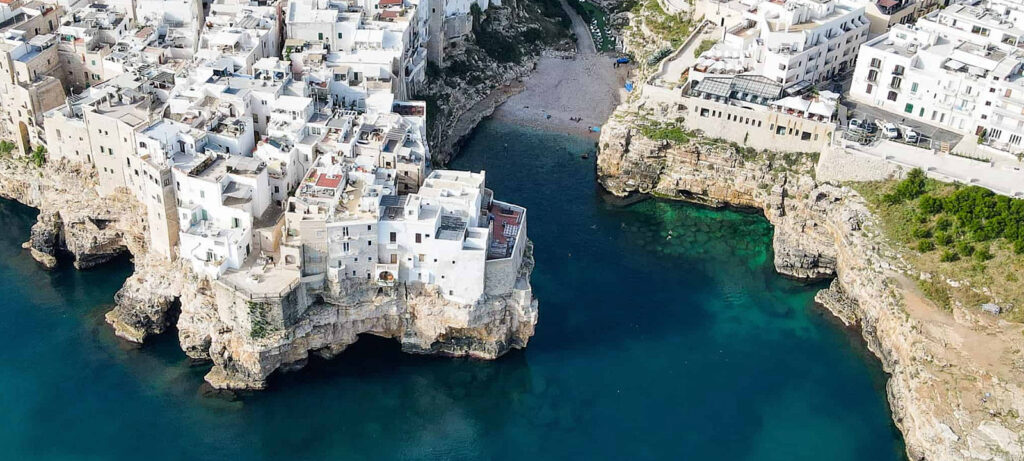
Even the coastline behaves laterally. There are dramatic cliffs near Polignano, yet vast stretches remain low and continuous. Beaches extend quietly. Sea access does not compress into a narrow promenade. The Adriatic and Ionian sides offer different textures without demanding allegiance to one.
Where Tuscany codified the estate into global symbol—cypress drives, vineyard symmetry—Puglia preserved agricultural function. The masseria system remained embedded in production. Olive harvest seasons continue to shape calendar. Wheat fields shift color with weather. Vineyards stretch outward without forming postcard compositions.
The difference is subtle but decisive. In Tuscany, estate life often feels curated for appreciation. In Puglia, it feels inhabited.
Attention and diffusion
In recent years, fashion houses, wedding planners, and hospitality brands have turned their attention toward Puglia. Images circulate—white tables set beneath pergolas, stone walls illuminated at dusk, guests dressed in linen against olive groves. For a moment, it appears as though the region might compress into a recognizable enclave.
But it does not.
The breadth of territory diffuses intensity. One wedding does not define a province. One hotel opening does not shift agricultural patterns. Visibility gathers briefly, then disperses across hundreds of kilometers of field and coast.
Evenings reveal the truth of it. As light lowers, the horizon widens. There are no narrow lanes funneling crowds toward a single piazza. Roads stretch quietly. In courtyards, dinner unfolds beneath vaults where conversation remains contained. The scent of olive wood smoke carries only so far before dissolving into open air.
Puglia hides in plain sight because it does not resist being seen; it simply does not reveal itself fully.
Long stays here depend less on spectacle and more on rhythm. Olive groves require tending. Local markets open early. Coastal winds shift by afternoon. Movement between northern Bari province and southern Salento spans real distance but rarely congestion. Two airports—Bari and Brindisi—anchor opposite ends of the region, allowing arrivals to distribute naturally rather than converge.
The landscape encourages coherence. Fragmented staffing introduces unnecessary interruption across territory already measured in hectares. Continuity—one coordinated presence managing sourcing, transport, reservations—aligns with the region’s inward logic. The estate functions as organism again, not as backdrop.
Puglia does not offer dramatic seclusion from above. It offers quiet enclosure from within. It does not elevate wealth; it absorbs it into land, into walls, into geometry that does not announce itself. The region’s openness is its camouflage.
From the road, it looks exposed.