
Sicily Does Not Concentrate Wealth—It Disperses It
An island where scale, legacy, and layered distance redefine private villa life
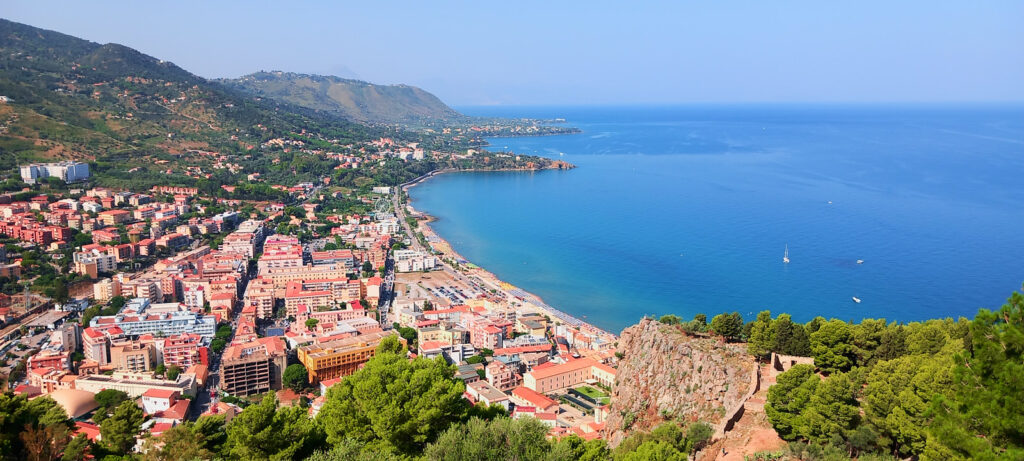
Sicily is rarely quiet in description. It is described as dramatic, volcanic, excessive, operatic. But that vocabulary belongs to those passing through. The island itself moves at a broader tempo. It does not compress identity into a single coastline or concentrate privilege into one corridor of villas and visibility. Instead, it stretches outward, allowing wealth, history, and retreat to spread across terrain wide enough to absorb them without distortion.
Where smaller Mediterranean enclaves gather attention tightly along promenades and harbors, Sicily distributes it across plains, hills, volcanic slopes, baroque towns, and outer islands. It is not that the island lacks icons—Taormina’s theatre above the sea, Palermo’s Arab-Norman geometry, Agrigento’s temples against the horizon—but that these icons do not compete for dominance. They coexist at distance from one another. Between them lies space. That space is the island’s quiet advantage.
Johann Wolfgang von Goethe, traveling through in 1787, wrote that “To have seen Italy without having seen Sicily is not to have seen Italy at all, for Sicily is the key to everything.” He sensed what first-time visitors still discover: Sicily explains the peninsula by refusing to resemble it. It is at once central and separate. A counterweight rather than an extension.
Counterweights do not cluster. They balance.
The geography of dispersion
Seen from above, Sicily appears almost continental in proportion. Twenty-five thousand square kilometers of terrain that shifts from citrus groves to volcanic black stone, from wheat fields to sheer coastline, from dense urban palazzi to inland estates measured not in square meters but in hectares. Scale here is not aesthetic; it is behavioral. It prevents compression.
On the eastern side, Etna rises as both landmark and climate regulator. Vineyards climb its slopes. Villas settle into elevations where the air thins and the sea becomes distant geometry rather than immediate horizon. Further south, the Val di Noto unfolds in baroque symmetry—towns rebuilt after catastrophe and aligned to light. To the northwest, Palermo’s architecture layers Norman, Arab, Spanish, and Italian influence into a single fabric that feels inherited rather than curated. Beyond, the western coast opens toward wind and salt, and further still the Aeolian Islands stand offshore, reachable only when sea and schedule allow.
Each region feels complete in itself. None overwhelms the others.
This dispersal creates privacy without announcement. There is no single social corridor where every arrival is registered. One may remain near Taormina yet live above its visibility. One may position inland among vineyards and olive groves without sacrificing cultural access. One may retreat to Pantelleria or the Aeolians, where maritime distance becomes its own threshold.
Sicily is an island, but within it exist islands again.
A history that refuses to condense
Sicily’s legacy is often narrated through intensity—aristocracy, exile, power, reinvention—but even its history resists concentration. The Florio dynasty built shipping and trade networks that extended beyond the island while embedding themselves deeply within it. Their villas were not seasonal gestures but nodes in economic ecosystems. Wealth in Sicily has long attached itself to land and infrastructure rather than to spectacle.
Giuseppe Tomasi di Lampedusa understood this tension when he wrote in Il Gattopardo, “If we want things to stay as they are, things will have to change.” Sicily changes at the surface. Regimes shift. Narratives evolve. Attention arrives in waves. Yet beneath that surface, estates remain. Agricultural cycles continue. Families hold.
Even the island’s mythologies—exported globally through fiction—have not reshaped its internal rhythm. The name Corleone circulates widely in cinema and conversation, yet daily life across the island unfolds according to agricultural calendars, local patron saints, and generational continuity. The mythology exists, but it does not dominate the land.
Leonardo Sciascia wrote simply, “Sicily is a metaphor.” He meant contradiction. Severity and generosity. Visibility and withdrawal. Pride and skepticism. For long-stay villa life, the metaphor becomes practical. Sicily allows one to inhabit complexity without being trapped within it.
Distance within distance
To live on Sicily for a week is one experience. To live on it for a season is another.
The island’s breadth allows movement without departure. One may begin on the Ionian coast and spend days among Etna’s vineyards before relocating west toward Palermo’s architectural gravity. One may divide time between coastal terraces and inland estates without boarding a plane. The distances are meaningful yet navigable.
Unlike smaller islands that empty themselves daily under the pressure of ferries, Sicily dilutes instead. Visitors disperse across its expanse. Congestion never fully coalesces into a single point. Privacy becomes a matter of positioning rather than timing.
Two major airports—Catania and Palermo—anchor opposite sides of the island, creating operational flexibility. Routes adjust. Staff and guests arrive from different directions. Supply chains diversify. The island feels expansive but not inaccessible. Scale introduces redundancy rather than isolation.
Evenings reveal the effect. Light stretches horizontally across plains instead of collapsing into a single promenade. Roads remain broad enough to avoid the sensation of being observed. Conversations unfold in courtyards where wind moves through stone archways and vineyards darken quietly beyond the walls. The sea is present, but not always immediate. One is aware of it without being defined by it.
Dispersion softens intensity.
Beyond standardization
Tuscany perfected a template. Villas, vineyards, cypress-lined drives—an aesthetic recognized globally. That recognition creates ease. It also creates repetition.
Sicily never adopted a single template. Architectural language shifts province to province. Coastal stone differs from volcanic basalt. Baroque façades give way to Norman arches. Agricultural life changes with elevation. Even dialects adjust subtly across distance.
Non-standardization demands attentiveness. It rewards those willing to learn rhythm rather than impose it. For families planning extended stays, this difference matters. The island does not perform a single identity; it offers several, none of which fully define it.
Economically, this translates into rare leverage. Prime coastal enclaves command valuations consistent with high-end Mediterranean markets, yet significant inland estates remain priced at levels that permit scale without compression. Cultural gravity—anchored by UNESCO sites that cannot relocate—remains constant. Demand rises and falls, but the land does not expand to accommodate it.
Sicily does not reshape itself around attention. It absorbs attention and continues.
Long-stay life here depends on coherence. Inland estates align with harvest and season. Coastal villas require awareness of wind and maritime access. Travel between micro-regions spans real distance. Fragmented staffing amplifies complexity across this terrain. Multiple agencies introduce handovers where continuity is required. Dispersion benefits from unity.
An integrated on-site presence—culinary planning synchronized with regional sourcing, transfers structured around dual gateways, reservations coordinated across provinces—transforms scale into stability. The island does not simplify itself; it responds to structure.
Sicily’s advantage is not spectacle. It is room. Room to reposition within the island without departing it. Room to remain unobserved even when global narratives circulate. Room for legacy to persist without codification.
Goethe saw Sicily as key. Sciascia saw it as metaphor. Both understood that it resists reduction. In a Mediterranean landscape where many enclaves compress wealth into narrow bands of repetition, Sicily distributes it across terrain vast enough to absorb it without altering its character.
Sicily does not concentrate wealth—it disperses it. In that dispersion lies its most enduring form of privacy.