
In the Alps, When Snow Falls, Money Rises
A seasonal territory where altitude sets the law and capital accepts it
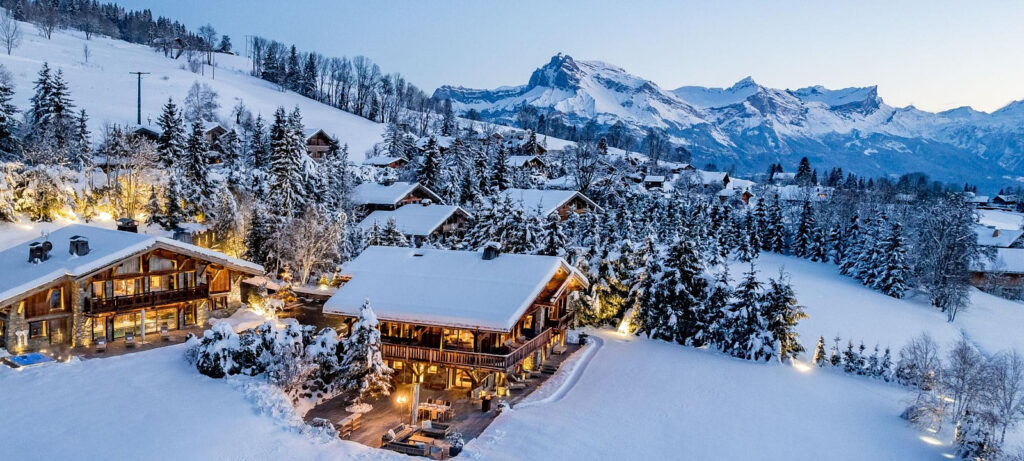
The Winter Alps — from the Italian Dolomites to Swiss Valais and French Haute-Savoie — operate under two quiet governors. Snow determines the season. Money defines the perimeter.From Milan, the high ground begins within reach. Two hours to Courmayeur. Three toward St. Moritz. Four toward Cortina d’Ampezzo. Livigno folds into its basin. Zermatt and Courchevel connect by rail into car-free centers or by mountain roads that narrow as altitude increases.The transition is gradual but absolute. Highways thin. Snow banks rise. Engines quiet. Movement slows by design. Winter does not begin at the chalet door; it begins during ascent.
Winter Starts on the Ascent
Unlike distant island retreats that demand long-haul flights and full detachment, the Alpine arc remains connected to primary life. Board meetings continue. Children shift between term schedules and ski mornings. Advisors operate remotely. The Alps extend ordinary rhythm rather than interrupt it.
Snow governs first.
It closes passes without negotiation. It redirects aircraft. It compresses geography into narrow corridors of intent. A scheduled landing near St. Moritz may divert to Bergamo. The final stretch becomes a coordinated drive through white silence — chains on tires, radios active, distance recalculated.
Arrival ceases to be casual. It becomes executed.
That execution sharpens experience. Effort is visible. Precision is shared among pilot, driver, chalet manager, ski technician. Winter exposes the system behind comfort. The result is not inconvenience but memory.
Albert Camus wrote, “In the depth of winter, I finally learned that within me there lay an invincible summer.” In the Alps, the meaning is structural. Winter removes distraction and reveals hierarchy. The mountain dictates pace. Capital aligns with that pace.
Money follows snow.
Where Altitude Shapes Value
Steep terrain limits footprint. UNESCO protections preserve Dolomite ridgelines. Swiss federal law restricts non-resident ownership and caps second homes in many municipalities near twenty percent of housing stock. French altitude zoning separates ultra-prime districts from lower villages. Italian valleys close seasonally, reinforcing access discipline.
Scarcity here is not aesthetic. It is regulatory and geological.
Prime Swiss and French resorts command roughly €30,000–€40,000 per square metre at the top tier; Italian and selected French locations often range nearer €20,000–€27,000 or below (Knight Frank Alpine Property Report 2026). Peak-season chalet rentals commonly sit between €20,000 and €60,000 per week, with ultra-prime exceeding that. The Alpine prime index rose 3.3% year-on-year to mid-2025 and 23% over five years — growth driven by restricted supply rather than expansion (Knight Frank 2026; Savills Ski Report 2025/26).
Elevation becomes insurance. Insurance attracts capital.
Above 1,800 meters, season certainty extends booking confidence. Glacier-linked domains lengthen the calendar into spring. High plateaus reduce volatility. In Zermatt, car-free policy removes drive-by exposure entirely. In Courchevel, altitude zoning protects stratification. The Engadine plateau around St. Moritz sits physically apart from through-traffic. Discreet Dolomite valleys near Cortina d’Ampezzo privilege legacy estates over hotel corridors. Livigno operates with fiscal nuance shaped by its duty-free status.
These structures were deliberate. Johannes Badrutt’s nineteenth-century wager repositioned St. Moritz as a winter destination rather than a seasonal accident. French planners elevated Courchevel by altitude tiers to preserve hierarchy through design. Over time, such decisions accumulated into an ecosystem where expansion is limited and return is habitual.
Families do not merely visit; they repeat. Seasons layer upon seasons. Children inherit slopes. Properties transfer slowly. UHNW buyers — from the United States, the United Kingdom, the Middle East, and North America more broadly — treat Alpine holdings as safe-haven assets with extended hold periods, not short-term trades (Knight Frank 2026; Savills Ski Report 2025/26).
High ground reshapes the calendar.
The infrastructure upgrades surrounding the 2026 Winter Olympics enhanced access and facilities without diluting structural character. Swiss stability continues to attract defensive capital. Italy’s flat-tax regime and Livigno’s historic fiscal status add discreet economic layers. None of this replaces snow as the governing force; it refines how money settles around it.
In this environment, fragmentation weakens flow. Winter already narrows margins — weather windows, transfer timing, slope conditions, equipment management. Multiple agencies introduce handovers precisely where continuity matters most.
Presence at the Right Altitude
A single trusted on-site husband-and-wife team — coordinating logistics, dining, movement, and daily rhythm without agencies or transitions — aligns naturally with the Alpine system. One point of contact preserves the uninterrupted sequence that altitude and regulation have already engineered.
The Winter Alps are governed by snow and money because both obey gravity.
Snow falls where elevation permits it. Capital settles where certainty protects it. Between them, a seasonal territory emerges — disciplined, cross-border, and enduring.
Those who understand its laws do not seek spectacle. They seek structure.
Across the Alpine Arc
The Winter Alps extend beyond a single resort. Each location carries its own altitude logic, access pattern, and social perimeter. Together, they form a connected high-ground landscape.
Explore the individual territories:
More territories will be documented as the road leads us back to them.