
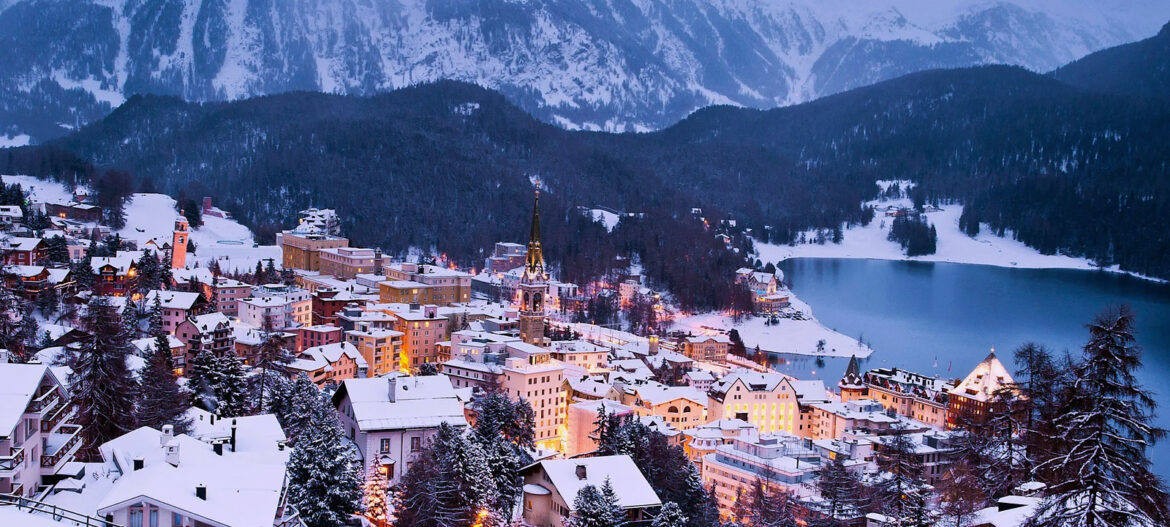
The original winter icon
There are mountain resorts, and then there is St. Moritz — the place where winter stopped being endured and started being staged.
Perched at 1,856 meters in the Upper Engadine, framed by a frozen lake and light so sharp it feels architectural, St. Moritz did not simply join the alpine conversation. It invented it. In 1864, hotelier Johannes Badrutt wagered that his English summer guests would find the Engadine winter sunny enough to sit outdoors in shirtsleeves. They returned. They stayed. Winter tourism was born.
More than a century later, the formula still works: altitude, clarity, ceremony — and a level of polish few destinations can maintain without becoming parody.
The grand hotels that shaped a culture
In St. Moritz, hospitality is not service. It is lineage.
Badrutt’s Palace rises above the lake like a fairytale citadel, hosting royalty, writers, and directors since 1896. Its lake-facing hall, afternoon tea rituals, and discreet piano evenings are not nostalgia; they are continuity. Across the village, Suvretta House offers its own private lift, Belle Époque grandeur, and a terrace lunch that turns fondue into theatre. The Kulm Hotel, where winter tourism truly began, still keeps its formal dining codes intact — crystal chandeliers, white gloves, and the kind of wine storytelling that slows time.
More contemporary, yet equally deliberate, Grace La Margna and the Grand Hotel des Bains Kempinski balance heritage architecture with updated spa culture, panoramic pools, and restaurants that draw guests who come as much for the table as for the slopes.
In St. Moritz, hotels are not accommodation. They are social ecosystems.
Skiing with an audience
The skiing is serious — but so is the audience.
Corviglia is the historic heart of the resort, wide and sunlit, where winter sport became spectacle. Corvatsch climbs higher, technical and dramatic, with night skiing under artificial light that feels cinematic. Diavolezza offers glacial descents and full-moon runs where silence is broken only by skis cutting snow.
Yet what defines St. Moritz is not just vertical drop. It is vertical living. Long lunches at Paradiso Mountain Club, seafood at altitude at Langosteria, DJ sets in alpine sunlight — skiing flows into dining without friction. On these slopes, people do not rush back down. They linger.
Winter here is a social season.
The Engadine circuit
St. Moritz is not isolated. It radiates.
A short drive brings you to Sils Maria, where Nietzsche wrote and lakes freeze into mirrors of sky. Zuoz, perhaps the most beautifully preserved village in the Upper Engadine, merges contemporary art spaces with patrician houses. In Pontresina, Belle Époque façades soften the mountain severity, while nearby Muottas Muragl offers one of the most dramatic dining rooms in the Alps.
The Engadine feels curated but never forced. It is alpine, but cultured. Remote, yet internationally fluent.
Where fashion met altitude
It is no coincidence that Coco Chanel wintered here, that Karl Lagerfeld reimagined it on a Paris runway, or that Slim Aarons found in these slopes his perfect composition of wealth and leisure.
St. Moritz understands presentation. Fur capes and Moncler tailoring, vintage Moon Boots and contemporary minimalism — the aesthetic remains precise but relaxed. Even the lake becomes a stage during White Turf, where thoroughbred horses race on snow in front of a crowd dressed as carefully as the riders.
This is a resort where appearance is not vanity. It is tradition.
Beyond skiing
Not everyone comes for speed.
Ice bathing, skijoring (a sport born here in 1906), moonlit forest walks, spa rituals scented with pine and larch — St. Moritz offers stillness as confidently as spectacle. Museums such as the Segantini Museum anchor cultural afternoons. Jazz lounges soften late evenings. The rhythm is flexible but intentional.
You can be active. You can be contemplative. You can do both in one day.
Why it still works..and it will
Myths are easy to create. They are harder to sustain.
St. Moritz survives not because of marketing, but because of consistency. The light remains clean. The service remains exact. The dining remains ambitious. The lake still freezes. The mountains still frame everything with quiet authority.
In many resorts, winter feels seasonal.
In St. Moritz, winter feels permanent — not in temperature, but in identity.
This is where winter learned to dress.
For those who prefer to experience St. Moritz beyond the grand hotel corridors, private chalets and alpine villas offer another dimension of the Engadine season. When supported by discreet on-site service — a private chef shaping evenings around regional ingredients and a dedicated driver navigating frozen mornings — winter unfolds at a different pace. The mountain remains the same; the experience becomes entirely your own.
St. Moritz does not slow winter down.
It gives it room to unfold.
Yes. Outside major events, St. Moritz becomes highly livable. Long winter stays benefit from its infrastructure, medical services, and rhythm that supports routine once the social calendar quiets.
Privacy and control. A chalet allows guests to enjoy the destination without engaging in its constant public visibility.
Very much so. Its scale, safety, and variety of non-ski activities allow families to maintain daily structure without relying solely on sport.